

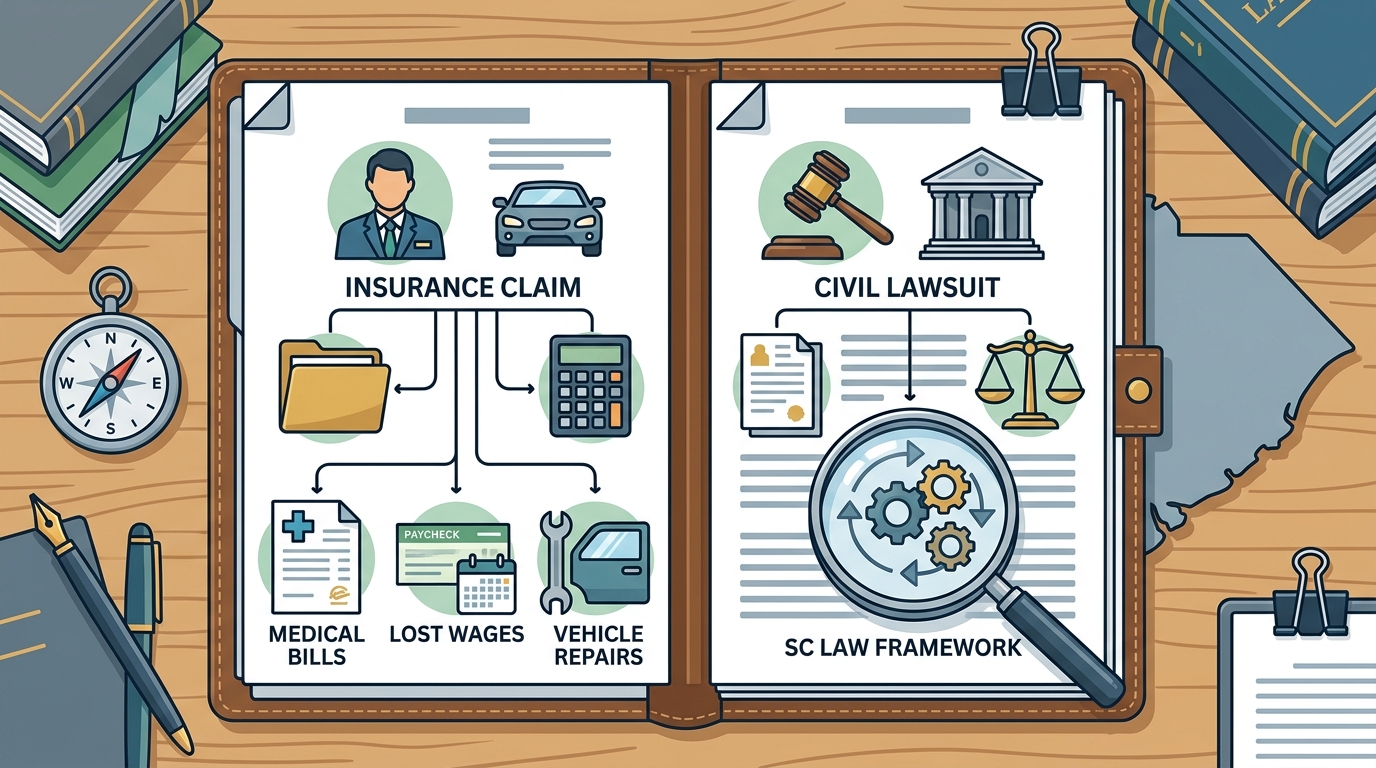
A car accident in South Carolina can leave you facing mounting medical bills, lost wages, and vehicle repairs. Understanding the legal avenues available to you is the first step toward recovering fair compensation. This ultimate guide walks you through every option—from insurance claims to civil lawsuits—so you can make informed decisions about your case.
South Carolina's At-Fault Insurance System
Before exploring your options, you need to understand the framework that governs every car accident claim in the state. South Carolina is an at-fault (tort) state. This means the driver who caused the accident bears financial responsibility for the resulting injuries and property damage.
In practical terms, the at-fault driver's liability insurance is the primary source of compensation for your losses. South Carolina law requires every driver to carry minimum liability coverage of $25,000 per person for bodily injury, $50,000 per accident for bodily injury, and $25,000 for property damage. Drivers must also carry uninsured motorist (UM) coverage at these same minimums.
Because South Carolina is a fault-based state, you do not simply file a claim with your own insurer the way drivers in no-fault states do. Instead, you pursue compensation from the person who caused the crash—or their insurance company.
Option 1: Filing a Third-Party Insurance Claim
The most common path after a South Carolina car accident is filing a third-party claim directly with the at-fault driver's insurance company. Here is what the process typically looks like:
- Notify the at-fault driver's insurer. Provide the claim number, police report, and basic details of the accident.
- Submit supporting documentation. This includes medical records, bills, proof of lost wages, photographs of the scene, and witness contact information.
- Wait for the investigation. The insurance company assigns an adjuster who reviews the evidence, inspects vehicle damage, and evaluates your injuries.
- Receive a settlement offer. Adjusters are trained to minimize payouts, so the first offer is almost always lower than what your claim is worth.
- Negotiate or escalate. You can counter the offer, provide additional evidence, or retain an attorney to negotiate on your behalf.
If the at-fault driver's policy limits are too low to cover your damages, you still have options—which leads us to the next section.
Option 2: Using Your Own Insurance Coverage
Your own auto insurance policy may contain several coverages that can help when the at-fault driver's liability insurance is insufficient or nonexistent.
Uninsured Motorist (UM) Coverage
South Carolina law mandates that every auto policy include UM coverage. This coverage pays if you are injured by a hit-and-run driver or an uninsured driver. It applies to both bodily injury and property damage, typically with a $200 deductible.
Underinsured Motorist (UIM) Coverage
UIM coverage is optional in South Carolina, but insurers are required to offer it to you. If the at-fault driver's policy limits do not fully cover your damages, UIM bridges the gap up to your own policy limits. For example, if your medical bills total $60,000 but the at-fault driver only carries $25,000 in bodily injury coverage, your UIM policy could cover additional losses.
Collision and Comprehensive Coverage
If you carry collision coverage, it pays for repairs to your own vehicle regardless of fault, minus your deductible. Your insurer then seeks reimbursement from the at-fault driver's company through a process called subrogation.
Medical Payments (MedPay) Coverage
MedPay is an optional, no-fault coverage that pays your medical expenses up to the policy limit regardless of who caused the accident. It can provide fast access to funds while your liability claim is still being processed.
Option 3: Filing a Personal Injury Lawsuit
When insurance negotiations fail to produce a fair settlement, you have the right to file a civil lawsuit against the at-fault driver. A lawsuit can seek compensation for:
- Past and future medical expenses
- Lost wages and diminished earning capacity
- Vehicle repair or replacement costs
- Pain and suffering
- Emotional distress
- Loss of enjoyment of life
- Wrongful death (filed by surviving family members)
The vast majority of car accident cases in South Carolina settle before trial. Settlements provide certainty—you know the amount and the timeline. However, if the insurance company refuses to offer fair compensation, going to trial may be the only way to pursue what you deserve. A jury could award more than the settlement offer, though there is always a risk of a lower award or no award at all.
How Comparative Negligence Affects Your Claim
South Carolina follows a modified comparative negligence rule. This means you can still recover compensation even if you were partially at fault for the accident—but there is a critical threshold.
- If you are 50% or less at fault, you can recover damages, but your award is reduced by your percentage of fault.
- If you are 51% or more at fault, you are barred from recovering any compensation.
For example, imagine your total damages are $100,000 and you are found 30% at fault because you were slightly exceeding the speed limit. Your recovery would be reduced to $70,000. Insurance adjusters routinely try to inflate your share of fault to reduce what they owe, which is why thorough evidence gathering—dashcam footage, witness statements, accident reconstruction—is so important.
Critical Deadlines: The Statute of Limitations
Every car accident claim in South Carolina is governed by strict filing deadlines. Under South Carolina Code § 15-3-530, you generally have three years from the date of the accident to file a personal injury or property damage lawsuit. This three-year window applies to injury claims, property damage claims, and wrongful death actions (though wrongful death claims run from the date of death, which may be later than the accident date).
Missing this deadline can be devastating. If you try to file after the statute of limitations expires, the defendant can have your case dismissed outright, regardless of how strong your evidence is.
Exceptions That May Extend or Shorten the Deadline
| Scenario | Deadline |
|---|---|
| Standard personal injury or property damage claim | 3 years from accident date |
| Claim against a government entity (city, county, state) | 2 years from accident date |
| Claim against the federal government | 2 years (with strict procedural requirements) |
| Injured person is a minor (under 18) | 3 years after turning 18 |
| Victim suffers mental incapacity | Up to 5 years from the accident |
| Delayed discovery of injury | 3 years from date injury was or should have been discovered |
| At-fault driver leaves South Carolina | Time absent from state may not count toward the 3 years |
These exceptions are narrow. You should never rely on an exception as a reason to delay taking action on your claim.
Special Rules for Claims Against Government Entities
If your accident involved a government vehicle—such as a police cruiser, county ambulance, or state maintenance truck—or was caused by a poorly maintained road or defective traffic signal, different rules apply under the South Carolina Tort Claims Act (S.C. Code § 15-78-10). The statute of limitations is shortened to two years, and there are additional procedural requirements that must be strictly followed.
Government claims also carry damage caps and immunity provisions that do not apply to claims against private individuals. An attorney experienced with tort claims against South Carolina government entities can help you navigate these additional hurdles.
Practical Steps to Take After the Crash
The actions you take in the hours and days following a collision directly impact the strength of your claim. Here is a step-by-step checklist:
- Check for injuries and call 911. Even if injuries seem minor, get a medical evaluation. Some conditions—internal bleeding, soft-tissue damage, concussions—may not be immediately obvious.
- Do not admit fault. Anything you say at the scene can be used against you during the claims process.
- Document everything. Take photos and video of vehicle damage, skid marks, road conditions, traffic signs, and any visible injuries.
- Exchange information. Get the other driver's name, phone number, insurance details, license plate number, and driver's license number.
- Talk to witnesses. Collect names and phone numbers of anyone who saw the accident.
- File or obtain a police report. South Carolina requires a report when there are injuries, fatalities, or property damage above $400.
- Notify your insurance company. Report the accident promptly but avoid giving a recorded statement before consulting a lawyer.
- Seek medical treatment promptly. Gaps in medical treatment give insurance adjusters ammunition to argue your injuries are not serious.
- Consult a car accident attorney. An attorney can advise you on the best claim-filing strategy, handle negotiations, and ensure you do not miss critical deadlines.
Key Takeaways
- South Carolina is an at-fault state—the driver who caused the crash is financially responsible.
- You have three primary options: a third-party insurance claim, using your own UM/UIM coverage, or filing a lawsuit.
- The statute of limitations is generally three years, but only two years for claims against government entities.
- Modified comparative negligence bars recovery if you are 51% or more at fault; otherwise, your award is reduced by your fault percentage.
- Minimum liability coverage in South Carolina is $25,000/$50,000/$25,000, which may not cover serious injuries.
- Acting quickly preserves evidence, strengthens your negotiating position, and protects your legal rights.
Frequently Asked Questions
How long do I have to file a car accident claim in South Carolina?
You generally have three years from the date of the accident to file a personal injury or property damage lawsuit under South Carolina Code § 15-3-530. However, claims against government entities must be filed within two years, and exceptions for minors, mental incapacity, or delayed discovery may alter the deadline.
Is South Carolina a no-fault or at-fault state?
South Carolina is an at-fault state that implements a tort system. The driver who caused the accident is responsible for paying damages through their liability insurance. You file a claim with the at-fault driver's insurer, not your own (unless you are using UM/UIM coverage).
Can I still get compensation if I was partially at fault?
Yes. Under South Carolina's modified comparative negligence rule, you can recover damages as long as you are 50% or less at fault. Your compensation will be reduced by your percentage of fault. If you are 51% or more at fault, you cannot recover anything.
What if the at-fault driver has no insurance?
South Carolina requires all drivers to carry uninsured motorist (UM) coverage. If the at-fault driver is uninsured or flees the scene, you can file a claim under your own UM policy to cover bodily injury and property damage.
What happens if the at-fault driver's insurance is not enough to cover my damages?
If your damages exceed the at-fault driver's policy limits, you may file a claim under your own underinsured motorist (UIM) coverage, if you purchased it. UIM coverage pays the difference up to your policy limits. You may also be able to sue the at-fault driver personally for amounts exceeding their coverage.
Should I accept the insurance company's first settlement offer?
Generally, no. Initial offers from insurance adjusters are typically well below the true value of a claim. Once you sign a release accepting a settlement, you give up your right to pursue any further compensation for that accident. Consult an attorney before accepting any offer.
Do I need a lawyer for a car accident claim in South Carolina?
You are not legally required to hire a lawyer, but navigating the claims process alone means dealing with adjusters trained to minimize payouts, calculating complex damages, and meeting strict legal deadlines. An experienced car accident attorney can significantly improve your chances of recovering full compensation.