

Longshore Act Compensation Guide: How to Get Paid for Work Injuries
Getting compensation for a work-related injury under the Federal Longshore and Harbor Workers' Compensation Act (LHWCA) requires filing a formal claim with the Office of Workers' Compensation Programs (OWCP). You must report the injury to your employer immediately and submit Form LS-201 to the designated OWCP district office. This guide covers the submission process, medical authorization, and dispute resolution for maritime workers in South Carolina.
OWCP Submission Process
The first step in securing benefits is filing the correct paperwork with the federal government. The LHWCA is a federal statute that provides medical benefits and wage replacement to workers who are injured on navigable waters. Unlike state workers' compensation, this process is handled by the Department of Labor's OWCP.
Form LS-201 and Employer Responsibilities
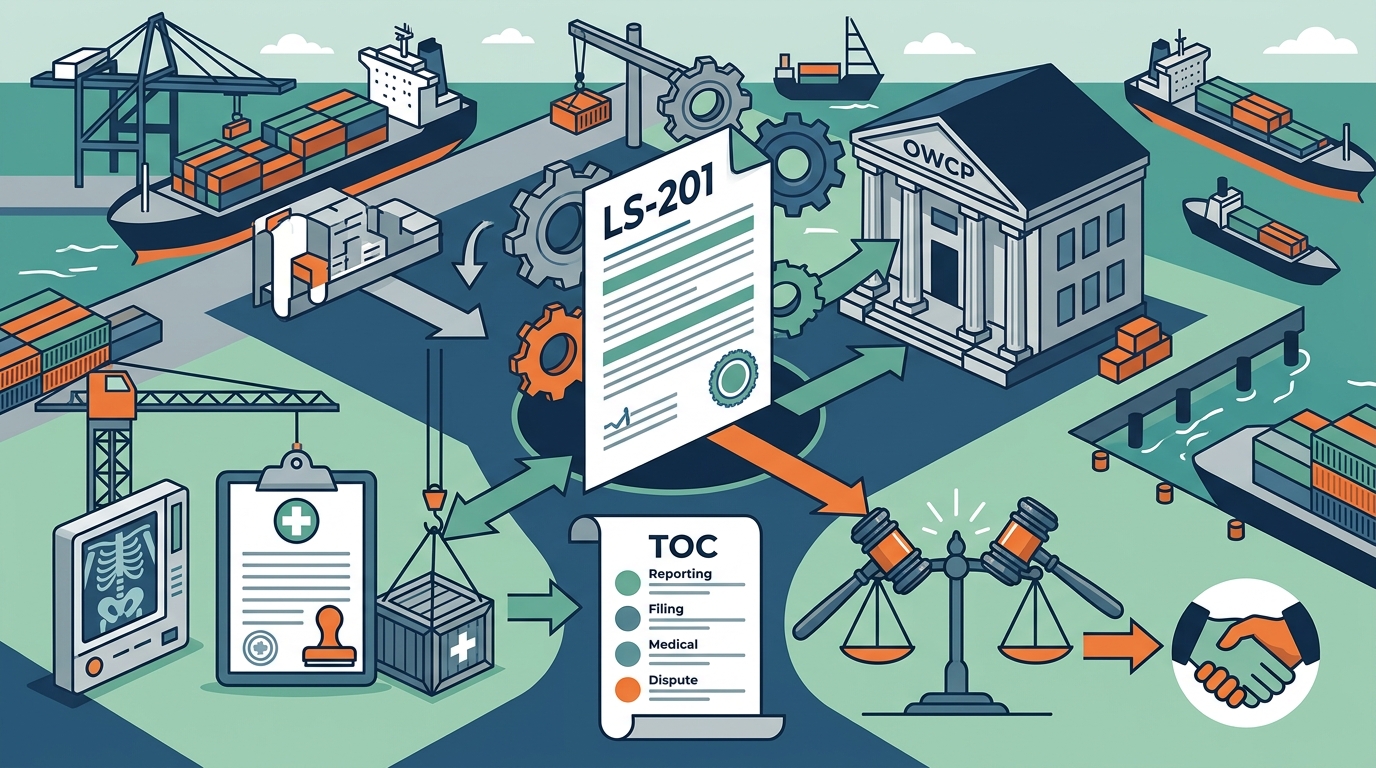
Form LS-201 is the application for compensation. You must file this form with the OWCP district office that has jurisdiction over your work location. Your employer is legally required to file Form LS-202, which is the employer's report of injury. If your employer fails to file this report, you can still proceed with your own LS-201, but the delay may affect the start date of your benefits.
Christmas Injury Lawyers assists clients in Charleston and across South Carolina with these filings. We ensure that the narrative of the injury is precise and that all supporting medical documentation is attached to the initial submission. Accuracy at this stage prevents early denials based on technical errors.
Statute of Limitations
The statute of limitations for filing a claim under the LHWCA is three years from the date of the injury. For occupational diseases, the clock starts when the worker knew or should have known that the condition was work-related. Missing this deadline permanently bars your claim. We advise clients to file as soon as possible to preserve evidence and start the benefits clock.
Medical Treatment Authorization
Medical care is the core of any LHWCA claim. The Act requires that the employer or their insurer provide all necessary medical treatment to cure the injury. This includes hospitalization, surgery, and prosthetic devices. You do not pay for these services upfront if the claim is accepted.
Choosing a Provider
Under the LHWCA, the employer or insurer generally has the right to select the initial medical provider. However, if you are dissatisfied with the care, you may request a change. The OWCP has specific rules regarding when a worker can choose their own doctor. This usually happens after the initial treatment phase or if the designated provider is unavailable.
It is critical to document every visit. Keep a log of dates, diagnoses, and treatments. If you are in South Carolina, our team helps coordinate with local medical providers to ensure that the treatment plan aligns with federal requirements. We also monitor the insurer's compliance with providing timely care.
Independent Medical Examinations
Insurers may request an Independent Medical Examination (IME) to assess the extent of your disability. You are entitled to be present during the IME. You should bring a copy of your medical records and a list of your symptoms. The findings of the IME can significantly impact your compensation amount, so preparation is key.
Dispute Resolution Procedures
If your claim is denied or your benefits are cut off, you have the right to appeal. The LHWCA provides a structured path for resolving disputes. This process is distinct from state workers' compensation appeals.
Administrative Appeals
First, you can file an appeal with the OWCP. If the OWCP denies your appeal, you can take the case to the Employees' Compensation Appeals Board (ECAB). The ECAB is a federal administrative body that reviews OWCP decisions. This stage is purely paper-based and does not involve a hearing.
Federal Court Review
If the ECAB upholds the denial, you may file a petition for review in a U.S. District Court. This is the final stage of the administrative process. At this point, the court reviews the record for legal errors. Christmas Injury Lawyers represents clients in these federal proceedings, ensuring that all procedural rights are protected.
Comparison of LHWCA and State Workers' Comp
| Feature | LHWCA (Federal) | State Workers' Comp (SC) |
|---|---|---|
| Governing Body | U.S. Department of Labor (OWCP) | South Carolina Workers' Compensation Commission |
| Eligible Workers | Longshoremen, Harbor Workers, Maritime | General State Employees |
| Statute of Limitations | 3 Years | 2 Years |
| Appeal Path | OWCP to ECAB to Federal Court | Commission to State Court |
Key Takeaways
- File Form LS-201 with OWCP within three years of the injury.
- Your employer must file Form LS-202 to report the injury.
- Medical treatment is provided by the employer or insurer initially.
- You can appeal denials through OWCP, ECAB, and Federal Court.
- Keep detailed records of all medical visits and symptoms.
- Consult a maritime attorney early to protect your rights.
- Do not accept a low settlement without legal review.
- Christmas Injury Lawyers specializes in these complex federal claims.
Frequently Asked Questions
What is the LHWCA?
The Longshore and Harbor Workers' Compensation Act is a federal law that provides benefits to workers injured on navigable waters.
Who is covered by the LHWCA?
Workers who perform work in a maritime capacity, such as longshoremen, harbor workers, and ship repairers, are covered.
How long do I have to file a claim?
You have three years from the date of injury to file a claim under the LHWCA.
Can I choose my own doctor?
Initially, the employer or insurer chooses the doctor. You may request a change under specific conditions.
What if my claim is denied?
You can appeal the decision to the OWCP, then to the ECAB, and finally to a U.S. District Court.
Do I need a lawyer for an LHWCA claim?
While not required, having an experienced attorney like those at Christmas Injury Lawyers significantly improves your chances of a fair outcome.
Conclusion
Navigating the federal LHWCA system requires precision and knowledge. From filing the initial LS-201 form to appealing a denial in federal court, every step matters. Christmas Injury Lawyers provides dedicated representation for maritime workers in South Carolina. We fight for the compensation you deserve. To start your case, today.